
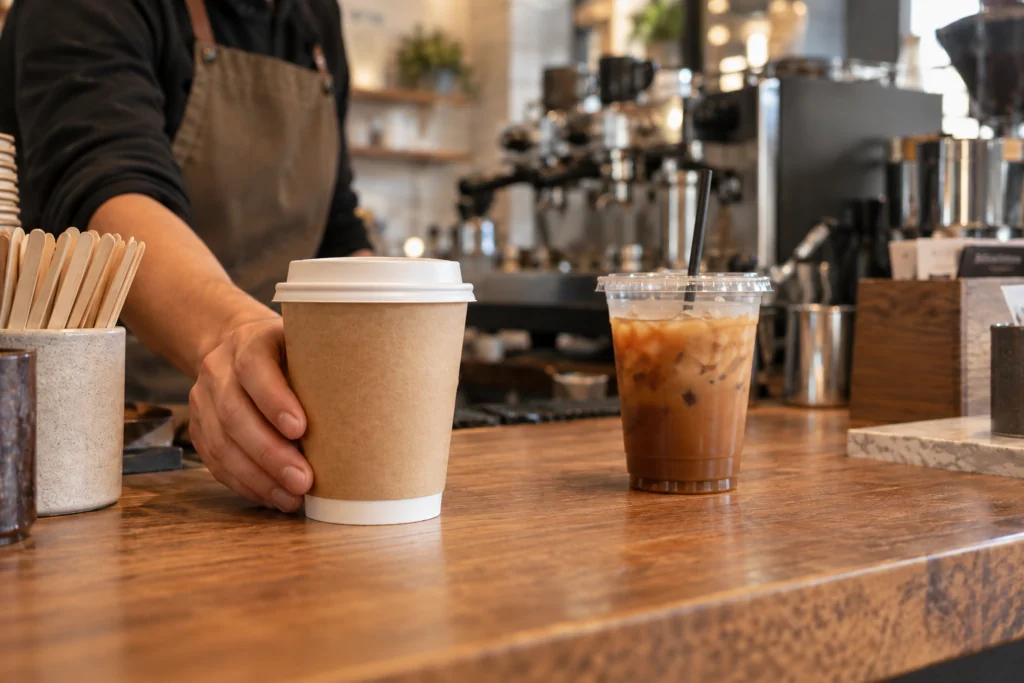
Coffee cups: paper or plastic? If you run a café, bakery, hotel, catering service or another business offering drinks to take away, your choice of material should not depend only on price or the appearance of the cup.
Drink temperature, thermal insulation, comfort when holding the cup, the lid, transport and how the waste will be managed afterwards are all factors that directly affect which format is best suited to your business.
For hot coffee to take away, paper offers a particularly useful range of solutions for professional use: different capacities, single- and double-wall cups, structures designed to improve insulation and a variety of finishes that can fit easily with the image of a café.
However, this does not mean that all paper cups are the same. The composition, internal barrier and intended conditions of use of each product remain important factors.
The question should therefore not simply be:
“Paper or plastic?”
but rather:
“Which cup best suits the drink, my operation and the image I want my business to convey?”
Coffee cups: paper or plastic? The main differences
Comparing the two materials helps to explain why paper cups are so widely used for professional takeaway coffee service.
| What your business should consider | Paper cups | Plastic cups |
|---|---|---|
| Coffee and hot drinks | Wide range of products designed for this use | Suitability depends on the polymer and individual product |
| Insulation | Available in single-wall, double-wall and other insulating constructions | Depends on the material and construction |
| Comfort when holding | Can be improved with a double wall or insulating structure | Depends on the format |
| Branding | Surface is well suited to graphics, colours and brand messages | Depends on the type of cup |
| Service image | Particularly suited to cafés, takeaway and a natural presentation | Different visual appearance |
| Coffee to go | Wide range of lids and accessories available | Depends on the individual product |
| Recycling | Depends on composition and the waste treatment system available | Depends on the polymer and collection system |
| Compostability | Only applies to products with the relevant characteristics | Depends on the material |
For a business that mainly serves coffee, tea, infusions or hot chocolate, paper offers a wide variety of solutions developed specifically for these types of drinks.
However, choosing correctly means looking beyond the material you can see.
Why choose paper cups for serving coffee?
Paper cups for coffee are widely used in foodservice because the container can be adapted both to the type of drink and to the level of insulation required for the service.
A solution designed for hot drinks
Freshly prepared coffee needs a container that can maintain its performance throughout the expected period of use.
The cup should:
- remain sufficiently rigid;
- be comfortable to hold;
- work correctly with its lid;
- be suitable for the intended temperature;
- make it easier to consume the drink away from the premises.
When choosing cups for a café, selecting the correct capacity is therefore not enough.
You should also check the intended use and temperature range of each individual product.
Single wall, double wall or an insulating structure?
One of the main selection criteria is the construction of the cup. A single-wall cup may be sufficient for certain drinks and service conditions.
Double-wall cups, on the other hand, include an additional structure between the hot drink and the customer’s hand. This construction helps to reduce heat transfer to the outside and can be particularly useful when the drink is going to be consumed on the move.
For a business, this means one important thing: do not compare only the unit price of the cup.
Consider the total cost of the service: cup + lid + optional sleeve + accessories + operational handling.
A cup with greater insulation may have a different unit cost, but depending on the type of service it may also reduce the need for additional components.
Choose the capacity according to your drinks menu
An espresso, cappuccino, latte or Americano do not require the same capacity.
Instead of using one oversized cup for the entire menu, it is often more efficient to work with two or three main sizes that cover most of the drinks you offer.
This can also simplify:
- stock management;
- product rotation;
- the number of product references;
- lid management;
- storage space;
- service speed during busy periods.
Cup, lid and cup carrier: think about the whole service
Choosing a good cup is only the first step. Once the coffee leaves the premises, the packaging needs to work as one complete system.
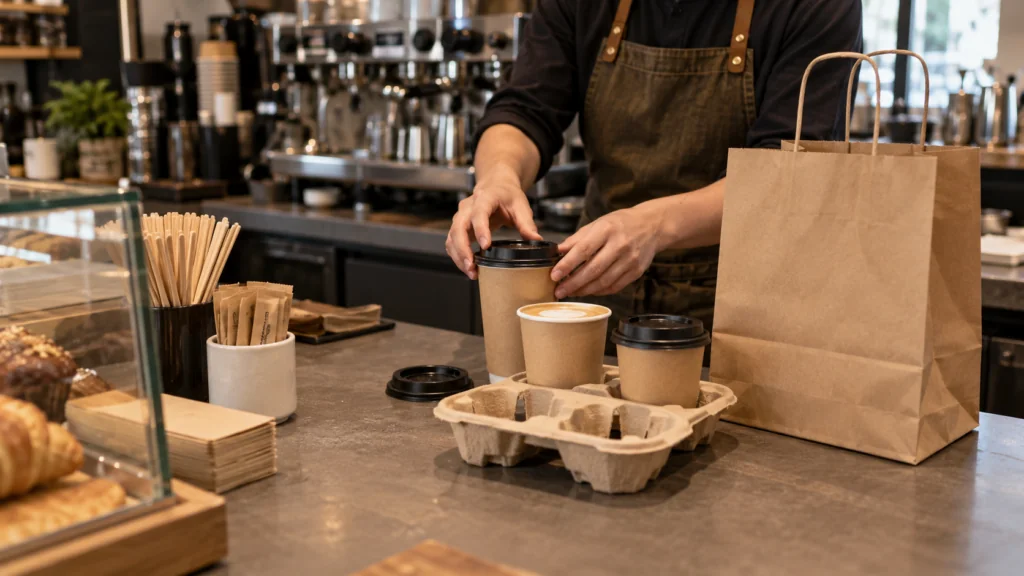
The lid must be compatible with the cup
A poorly fitting lid can cause leaks even if the cup itself is perfectly suitable for the drink.
Before introducing a new format, check:
- the top diameter;
- compatible lids;
- closure quality;
- how easily the lid can be fitted;
- the drinking opening;
- performance during transport.
Two cups with similar capacities do not necessarily use the same lid.
Fewer diameters can simplify stock management
When several cup sizes are compatible with the same family of lids, the number of products that need to be stored can be reduced.
In practice, this can mean: fewer mistakes + less storage space + simpler restocking.
This can be particularly useful during busy service periods.
Cup carriers become more important with multiple drinks
When a customer orders two, three or four drinks, it is no longer enough to make sure that each individual cup is properly closed.
They also need to be transported securely.
Cup carriers are particularly useful for: takeaway, delivery, catering, office orders, corporate breakfasts and events.
Professional purchasing should therefore consider the entire journey of the drink, from the counter to the customer.
The paper cup is also part of your business image
With takeaway service, the packaging leaves the premises with the customer. This means that the cup can become an additional communication tool.
Paper is well suited to:
- logos;
- brand colours;
- messages;
- QR codes;
- personalised graphics;
- temporary campaigns.
For a café with a high volume of takeaway orders, each cup can become another point of contact between the customer and the brand.
Before ordering large quantities of personalised cups, however, it is worth considering monthly consumption, minimum order quantities, how long the design will be used and the storage space available.
What limitations does plastic have compared with paper for serving coffee?
When comparing coffee cups: paper or plastic, plastic should always be assessed according to the actual use of the drink.
Not every plastic cup is designed to hold hot coffee. Capacity alone does not tell you whether a container is suitable for a freshly prepared hot drink.
You need to know: material + permitted temperature + intended conditions of use.
For a café whose service is mainly based around hot drinks, paper has a practical advantage: there is a wide range of formats specifically developed for coffee, tea and other hot drinks.
A transparent cup can make sense for some cold drinks where showing ice, layers or toppings is part of the presentation, but this is a different requirement from the hot takeaway coffee service discussed in this article.
For a drinks menu focused mainly on hot beverages and takeaway, paper is therefore particularly well suited to this type of professional service.
Not all paper cups have the same composition
Choosing paper does not mean that there is nothing else to check.
Two cups that look very similar can have different compositions. To hold liquid without losing strength, paper or board needs a suitable moisture barrier.
PE, PLA and other barrier systems
Different solutions may be used depending on the product. Some cups include a PE coating, while others may use PLA or other types of barrier.
You should therefore not automatically assume that: paper cup = plastic-free cup.
The composition can affect:
- product performance;
- waste management;
- recycling;
- labelling;
- environmental claims.
Always check the product information
Terms such as: plastic-free, recyclable, biodegradable or compostable, should not be used automatically simply because the main material of the cup is paper.
Any claim should be supported by the actual characteristics of the individual product.
For a professional business, the simplest rule is: check first, communicate afterwards.
Recyclable, biodegradable and compostable do not mean the same thing
These terms often appear together when discussing sustainable packaging, but they are not synonyms.
A product can be recyclable without being compostable. Another may be suitable for industrial composting but not for home composting.
The fact that the main material is paper does not automatically determine how the cup should be managed at the end of its useful life.
Can paper cups be recycled?
This depends on the composition of the product and on the collection and treatment infrastructure available.
The internal coating, combination of materials and local waste management system can all affect the recycling process.
It is therefore important to consider both the specific characteristics of the product and the applicable waste disposal guidance.
Greenuso also has a dedicated article explaining how to recycle paper cups correctly, so this topic can be explored further through internal linking without unnecessarily duplicating existing content.
Are all paper cups biodegradable or compostable?
No. These characteristics must be checked for each individual product and, where necessary, supported by the relevant certification.
It is also important to distinguish between: industrial composting and home composting.
A material designed to break down under controlled industrial conditions should not automatically be considered compostable in every environment.
For a business that wants to communicate its choice accurately: check the characteristics first and only then use the relevant claim.
Food safety: the cup must be suitable for its intended use
Choosing paper instead of plastic does not mean presenting one material as safe and the other as dangerous.
Materials and articles intended to come into contact with food must comply with the requirements applicable to their intended use and food safety.
For a café, the practical question is: is this cup designed to hold this drink at the temperature at which I intend to serve it?
The same check should also be carried out for:
- lids;
- internal coatings;
- other components that may come into contact with the drink.
Documentation is more reliable than appearance
A cup may look thick and strong, but visual appearance does not replace technical product information.
Likewise, a product that looks lighter may be perfectly designed for its intended use.
In a professional business, technical documentation and intended conditions of use should take priority over visual assumptions.
Sustainability is about more than simply replacing plastic
The fact that paper is more closely aligned with the Greenuso range does not mean sustainability should be reduced to a comparison between two materials.
The total amount of packaging used for each order should also be considered.
It is worth assessing:
- the correct cup size;
- whether a lid is actually necessary;
- whether a protective sleeve is needed;
- stirrers;
- cup carriers;
- the total number of components used;
- how the waste will be managed afterwards.
Use only the accessories each order actually needs
A coffee that is going to be consumed immediately may require a different setup from a drink prepared for delivery.
Automatically adding: cup + lid + sleeve + stirrer + cup carrier
when some of these elements do not serve a practical purpose increases material consumption without providing a genuine benefit.
More responsible service also involves reducing unnecessary accessories.
How to choose paper cups for your type of business
Cafés and bakeries
If you prepare large numbers of hot drinks during busy periods, focus particularly on:
- capacities suited to your menu;
- insulation;
- service speed;
- stackability;
- compatible lids;
- comfort when holding the cup;
- ease of storage.
If you add a protective sleeve to almost every order using a single-wall cup, it may be worth comparing the total cost with a double-wall solution.
Takeaway and delivery
When coffee needs to be transported, the quality of the closure becomes even more important.
Assess: cup + lid + stability + transport.
A practical test can be very useful: prepare a real drink, fit the lid, place it in your usual transport system and simulate the journey it will make before reaching the customer.
Catering and events
When a large number of drinks need to be served in a short period, other criteria become particularly important:
- stackability;
- storage;
- quick restocking;
- the number of different formats;
- ease of transport;
- waste sorting afterwards.
At corporate events, personalising the cup can also help reinforce brand identity.
Offices and businesses
In offices, simplifying the system is often the most efficient option.
Using a small number of cup sizes and, where possible, lids that are compatible with several formats can make restocking easier and reduce the amount of storage space required.
It is also worth taking into account the waste sorting system available within the workplace.
What to check before buying paper cups for your business
Before choosing a particular product, ask yourself these eight questions:
- What drink will I be serving?
- At what temperature will it be served?
- What capacity do I actually need?
- Will the drink be consumed immediately or transported?
- Is a lid or additional insulation required?
- What is the exact composition of the cup?
- Which environmental claims are genuinely verified?
- How will the cup be managed after use?
Only then does it make sense to compare price, colour, design and personalisation options.
Frequently asked questions about paper coffee cups
Are paper cups suitable for hot coffee?
Yes. There are many models specifically designed for hot drinks.
However, the intended conditions of use of each individual product should always be checked.
What is the difference between single-wall and double-wall cups?
A double-wall cup includes an additional structure between the hot drink and the outer surface.
This helps to reduce heat transfer to the outside.
It can be particularly useful for hot takeaway coffee.
Does a paper cup always need a protective sleeve?
No. It depends on the construction of the cup, the temperature of the drink and the thermal performance of the product.
A cup with greater insulation may reduce the need for an additional accessory.
Are all paper cups recyclable?
This should not be assumed. Whether a cup can be recycled depends on its composition and on the treatment systems available.
Are all paper cups compostable?
No. Compostability must be a specific characteristic of the individual product and, where necessary, supported by the corresponding certification.
What capacity do I need for coffee?
It depends on the drink. Espresso, cappuccino, latte and Americano do not require the same cup size.
The best approach is to match cup capacities to the actual drinks menu of the business.
Coffee cups: paper or plastic? Which is better for hot drinks?
For a business focused mainly on hot coffee and takeaway drinks, paper cups are available in a wide variety of capacities and constructions specifically developed for this type of use.
Double-wall models can be particularly useful when additional insulation and greater comfort during transport and consumption are required.
Coffee cups: paper or plastic? Why paper suits your business
The comparison coffee cups: paper or plastic often starts as a simple question about material. For a professional café, however, the decision should primarily be based on the actual performance of the product.
When your service focuses mainly on: hot coffee + takeaway + customer comfort + brand image + reducing conventional plastic solutions
paper offers a particularly suitable combination.
You can choose from different capacities, single- and double-wall constructions, kraft or white finishes and formats specifically developed for hot drinks.
The key is not to buy just any paper cup.
It is to choose the right paper cup: appropriate capacity + required insulation + compatible lid + known composition + verified environmental characteristics + a format suited to your day-to-day operation.
The cup then becomes more than simply a container. It becomes part of the customer experience, service efficiency and the identity of your business.