
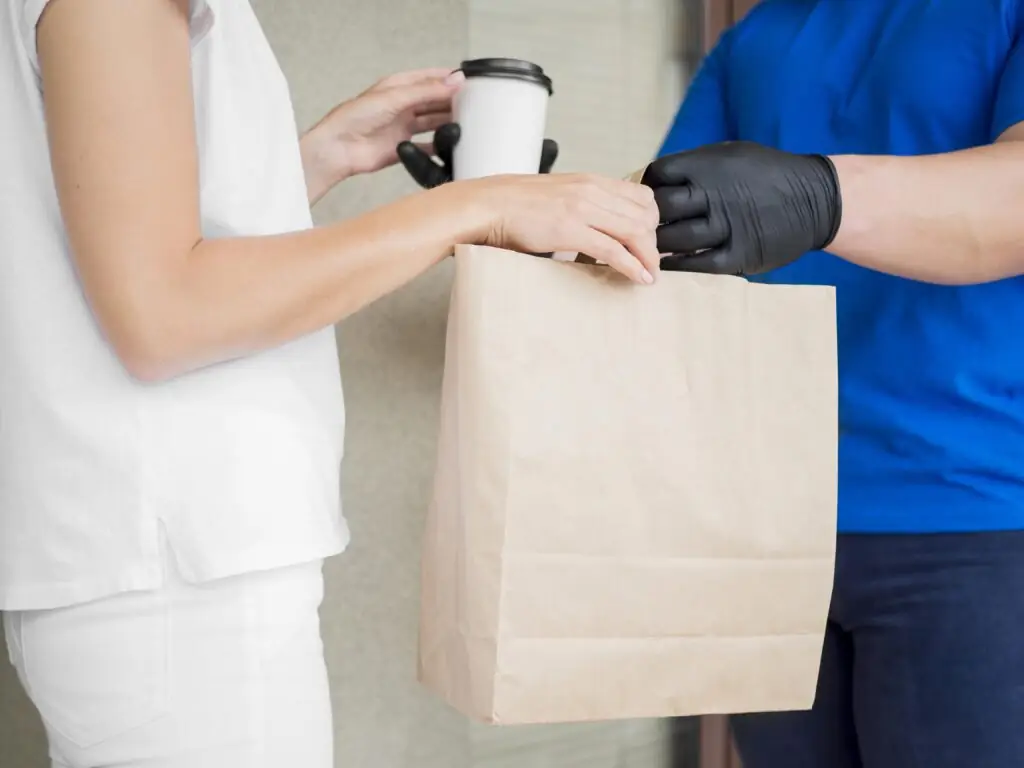
Understanding the difference between take away and delivery helps hospitality businesses better respond to their customers. Both methods have advantages and challenges. Knowing their characteristics allows tailoring services and seizing new opportunities in a market that values convenience.
What is take away?
Take away is based on the customer coming to the premises, placing an order, and picking it up to consume elsewhere. It does not involve table service or home delivery. It is common in cafes, restaurants, and fast-food chains.
Evolution of take away
This system emerged as a response to the need of customers who value speed. Since its origins in the sale of take-out food in small establishments, take away has evolved. Today, technology and changes in living pace have made this method a key option for those looking to save time without forgoing a complete meal.
Adaptation to current lifestyle
Nowadays, take away offers solutions to fast-paced life. It allows picking up orders in adapted time slots, sometimes with prior online reservation. Businesses invest in packaging that better preserves the quality of food and in fast ordering systems, optimizing the customer experience and ensuring that the product arrives in optimal conditions for immediate consumption.
Main features of take away
- In-person pickup: The customer is responsible for picking up the order.
- Speed: Speeds up delivery and minimizes waiting times.
- Time control: The consumer chooses when to pick up their food.
- Lower logistical costs: By not requiring delivery, it reduces expenses and simplifies internal processes.
In short, take away is a flexible system that adjusts the hospitality offer to the needs of those looking for immediacy and autonomy in collection, leveraging the infrastructure of the premises.
What is delivery?
Delivery is a service where the order, prepared by the establishment, is sent directly to the customer’s specified address. The user does not have to travel; the product arrives at their home, office, or chosen place. This facilitates access to a wide gastronomic offer without the need to leave.
Growth and transformation of delivery
The rise of delivery is tied to technological development and the massive use of mobile apps. Thanks to digitization, orders can be quickly placed from any device. Online platforms have enhanced the experience and boosted logistical efficiency, allowing tracking of shipments and secure payment management.
Advantages and reach of delivery
The operation of delivery allows businesses to reach more customers, expanding their area of influence beyond the physical location. This is especially relevant in urban areas and in cases where mobility is limited. The service requires solid organization to coordinate preparation, proper packaging, and optimal transport conditions.
Delivery characteristics:
- Home delivery: The customer receives the order at their chosen location.
- Greater convenience: The consumer does not travel and saves time.
- Access to a wider audience: The restaurant can serve outside its usual environment.
- Dependence on logistics: Quality depends on delivery, packaging, and delivery times.
Delivery is, therefore, a solution designed for those seeking maximum convenience and access to catering, representing an increasingly important alternative in the strategy of hospitality businesses.
Main differences between take away and delivery
Analyzing the differences between take away and delivery helps understand how each modality adapts to customer expectations and affects the business model. Several factors distinguish them clearly:
Form of delivery
- Take away: The customer travels to the establishment to pick up the order.
- Delivery: The order is transported to the customer, who receives the food at a location of their choice.
This fundamental difference defines the logistics, resources, and time dedicated by the business and the user.
Presentation and preparation
- In take away, the packaging prioritizes ease and safety in manual transport. It ensures that the food maintains its temperature and is properly preserved for consumption close in time and space.
- In delivery, preparation and packaging require more attention. It is crucial to maintain the perfect state of the food after a longer journey. Moisture-resistant, impact-resistant, and thermally-retentive packaging is used, meeting demanding transport and presentation standards.
Logistical impact and costs
- Take away: Requires fewer resources for delivery and transportation. Logistical expenses are usually limited to internal organization and pickup space arrangement. Investment in packaging is important but less than in delivery.
- Delivery: Involves comprehensive delivery management, whether with own or external resources. There are additional costs in transportation, personnel, technology, and specialized packaging. It also requires tracking systems to monitor shipments and ensure quality until delivery.
Customer experience
- Take away offers speed and independence, attracting users who want to control the timing of pickup and consumption.
- Delivery is associated with total convenience, allowing enjoying the menu without leaving home or office, eliminating any travel.
In short, each method responds to different needs, and integrating them into the hospitality offer can make a difference in customer satisfaction and loyalty. Using the right modality or combining them depends on each business strategy and the preferences of the target audience.

Impact and profitability in hospitality businesses
The choice between take away and delivery has a direct impact on costs, profits, and the commercial margin of hospitality businesses. Analyzing the impact of both modalities helps make more profitable decisions tailored to each business model.
Costs and benefits
- Take away: Implies lower logistical expenses, as it does not require delivery personnel or vehicles. Savings on delivery costs improve profit per order and reduce operational complexity. However, the sales volume is usually limited to the local clientele or those who can travel.
- Delivery: Increases operational costs due to the need to manage delivery, invest in technology, specialized packaging, and, in many cases, commissions to external platforms. In return, it allows expanding the customer base and accessing areas where the physical business would not have reach, translating into a significant increase in orders and revenue.
Choice according to the type of business
Internal structure, location size, and client profile influence the choice. Businesses with a large flow of nearby customers, limited hours, or small teams can leverage take away as the main source of income. Those with the capacity to handle logistical and organizational challenges can use delivery to grow and diversify their activity.
Trend towards combined models
Recent trends in hospitality show that combining take away and delivery provides flexibility and adaptability. Integrating both services allows capturing different customer profiles and offering responses to various consumption needs, boosting the overall profitability of the business.
Adopting a strategy that combines both options, with effective management and an offer adapted to each channel, is key to ensuring sustainability and growth in a competitive market.
Key points to optimize take away and delivery services
Management of take away and delivery requires attention to several factors to ensure efficiency, quality, and a satisfactory customer experience. These key points are essential:
1. Efficient management
- Optimizing internal processes reduces waiting times and improves service.
- Digitalizing orders and payments streamlines operations, avoiding errors and unnecessary backlogs.
- Smooth coordination between kitchen, packaging, and pickup or delivery area is key to meeting promised times and avoiding complaints.
2. Quality packaging
- Packaging must protect the food, maintain its temperature, and ensure products arrive A fresh-looking.
- Sustainable solutions, like those from Greenuso, add value to the business, improve customer perception, and can reduce environmental impact.
- Choosing packaging according to the type of food (liquid, hot, cold, or crispy) prevents quality losses during long journeys or waits.
3. Anticipation of common challenges
- Identifying potential issues, such as delays, spills, mixing of odors, or incomplete orders, allows implementing quick and effective solutions.
- Informing the customer about schedules, estimated waiting time, and contact channels helps manage expectations and avoid frustrations.
4. Practical tips to boost satisfaction
- Train staff in handling and packaging.
- Review orders before delivering or sending them out.
- Request customer feedback to identify areas for improvement.
- Adapt the menu to products that travel well and maintain their quality outside the premises.
- Provide consumption, reheating, or storage instructions when necessary.
Applying these recommendations to take away and delivery services can increase customer loyalty and improve the business’s reputation in an increasingly competitive sector.